Dr. Canary
Choose one job the store can measure
Take an after-hours availability question. Have a salesperson show you how they answer it today, how long it takes, and what gets the customer a useful answer. That is your starting point for the pilot.
Decide which facts the reply can trust
For an inventory reply, write down the VIN, the source of availability, who owns that source, and how old a record can be. If the feed is stale, offer a handoff to someone who can check the lot.
Give each action its own permission
- Drafting and sending
- Start with drafts a salesperson can review. Give sending its own application permission and name the person who can switch it off.
- Making a promise
- A booking needs a scheduler confirmation. A price needs an approved source. Test that a customer message cannot override either rule or expose another shopper’s record.
Before go-live, test what changes mid-conversation
Use a test customer and agree on the expected reply before the run. Save the source record, the application log, and what arrived on the phone.
- The vehicle is available
- Ask about a specific VIN. Check that the draft names the right vehicle and accurately reflects the latest inventory record.
- The vehicle sells
- Mark that VIN sold before the next reply. The reply should say it sold, and the queued invitation to see it should stop.
- The feed stops updating
- Let the record pass its freshness limit. Verify the handoff reaches a person and the shopper gets a way to continue.
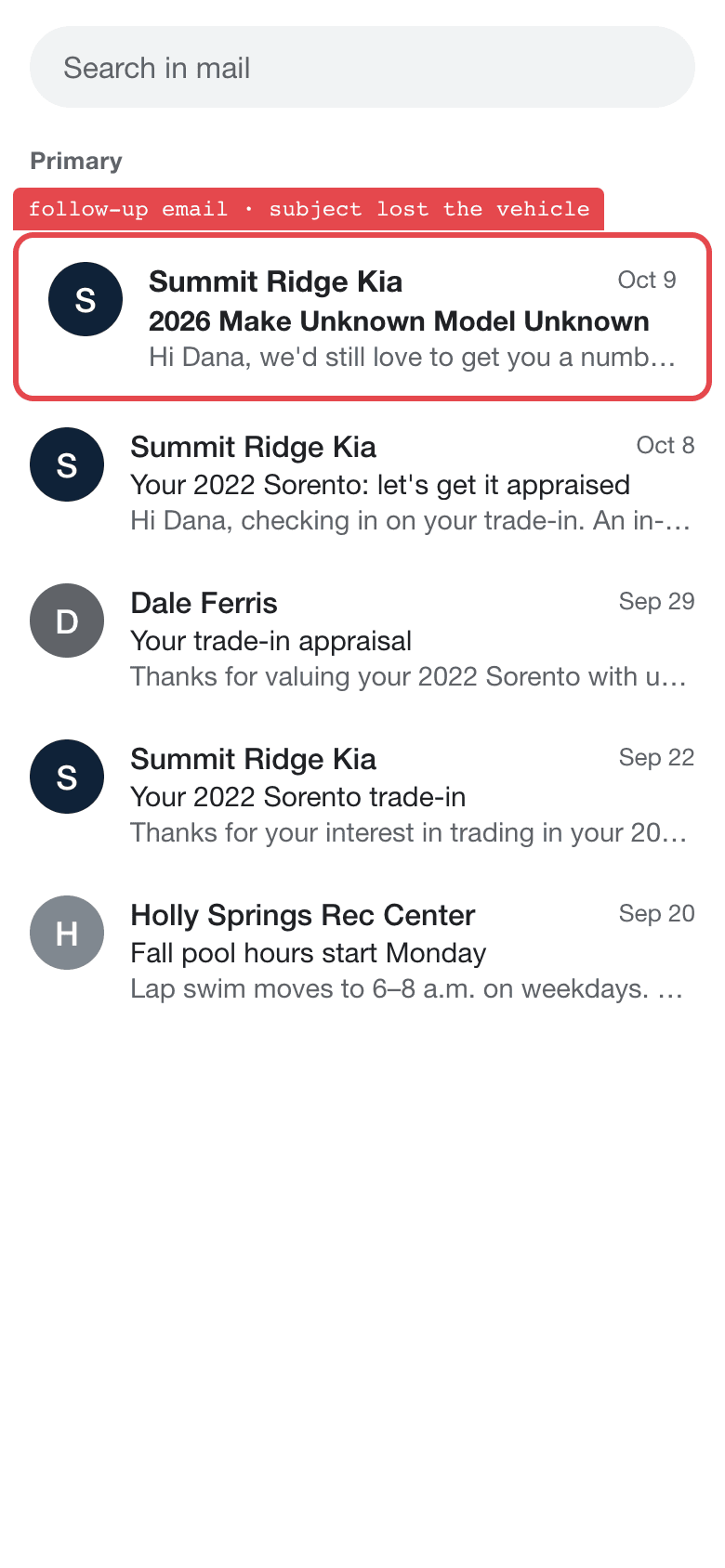
A trade-in inquiry named a 2020 Silverado. The first reply named it too and offered an appraisal. Seventeen days later a follow-up arrived with the subject “2026 Make Unknown Model Unknown.”
The capture, in the guideOn launch day, start with a limited pilot
Enable one team and one action. Send the same test inquiry through the live site. Match the phone reply to the VIN and the inquiry in the CRM. Have a named reviewer approve the first sends and switch back to drafts if a check fails.
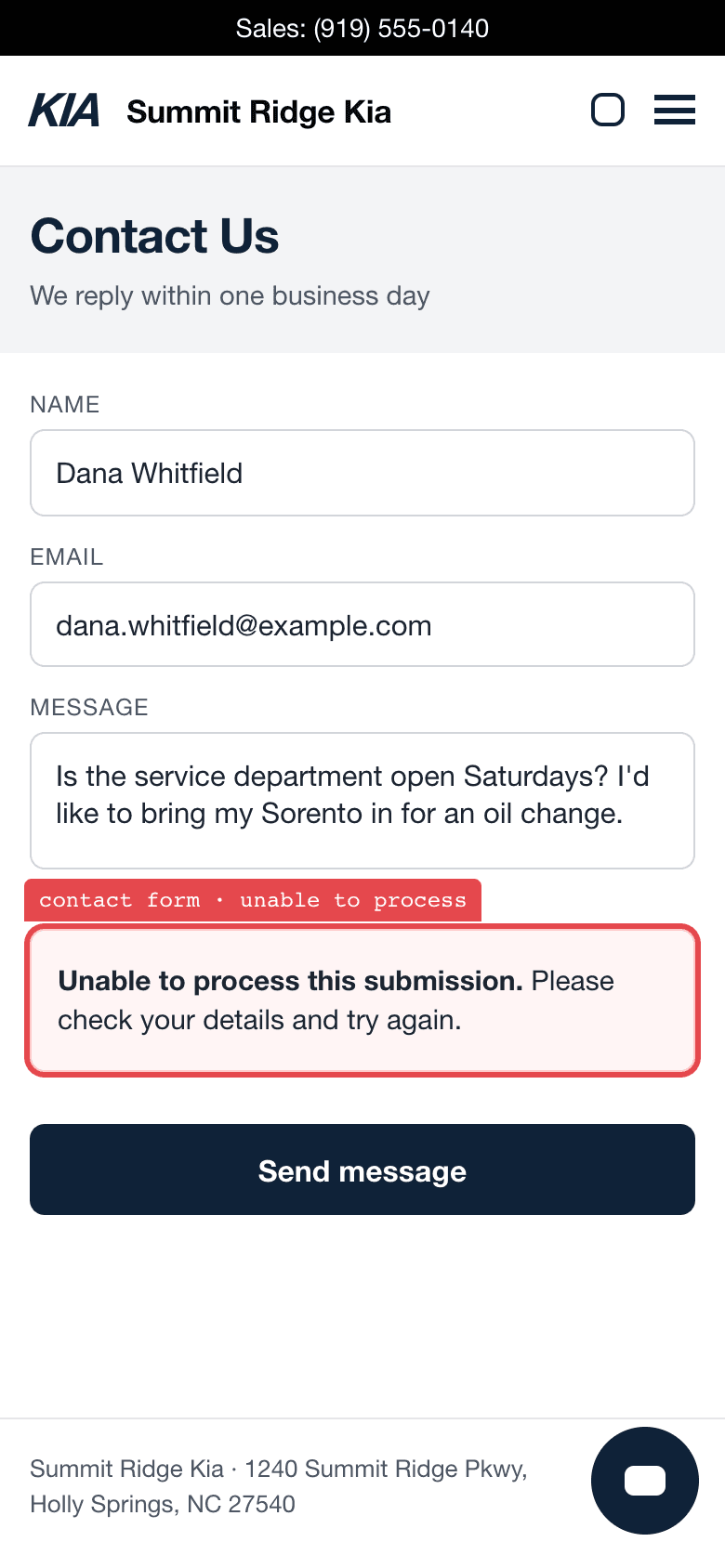
The general contact form came back “Unable to process.” The price inquiry on a vehicle page, the same day, went through.
The capture, in the guideMonitor before expanding
Agree on a review schedule and an owner before the pilot opens. Sample received replies and handoffs. Rerun the sold-vehicle and stale-feed cases whenever the model, feed, or permissions change.
- Review failures
- Give staff a way to flag a wrong answer with its source record. Pause the affected action, correct it, and rerun the failing case.
- Decide whether to expand
- Compare the pilot with the starting records. Did shoppers get accurate answers sooner? How much review time did the team spend? Expand when the gain justifies the cost and staff can handle the work.
Eight moments on the shopper’s path
Pick a question your team hears often. See what AI could draft and what your store would need to check.
Is the service department open on Saturday?
- What AI could draft
- An answer from the store’s own pages: hours, departments, directions and the scheduler link for the right department.
- What to check first
- Whose job is the hours page today, and when was it last touched?
 Two booking routes, one confirmed reservation
Do you still have the white Telluride?
- What AI could draft
- The stock number, a vehicle link that opens on a phone, and the two closest units if it sold.
- What to check first
- How old is the feed a draft would answer from at 7 pm?
 The inventory answer arrived. The offer terms didn’t.
What would you give me for my 2022 Sorento?
- What AI could draft
- The range the valuation tool showed, what it rests on, what the appraisal will check, and a way to send photos.
- What to check first
- What can a reply honestly say before an appraiser has seen the car?
 The appraisal was explained. Later messages lost detail.
I filled out the form on the Sportage. Who do I talk to?
- What AI could draft
- A route by department, language and who is on, and a first reply that names the person.
- What to check first
- Does the CRM know who is on the floor tonight, or does a person?
 The contact form said no
Actually, can you tell me about the Sportage instead?
- What AI could draft
- A reply built from the whole thread and the vehicle named last, with the queued follow-up paused.
- What to check first
- Does the next message know what the shopper said last?
 A later email lost the vehicle.
Can I drop off before you open?
- What AI could draft
- The drop-off instructions, where the key drop is, the shuttle hours, what to bring.
- What to check first
- Could an advisor’s answer come from one page the store already keeps?
Two booking routes, one confirmed reservation What did you end up doing, and when am I due back?
- What AI could draft
- A plain summary of the work done, the work declined, and the next due service with a date.
- What to check first
- What does the customer hear after the repair order closes, and from whom?
Does this roof rack fit a 2021 Sorento?
- What AI could draft
- A yes or no from the catalog by VIN, the price, stock, and pickup or install options.
- What to check first
- Can a draft see the catalog by VIN, or only the part number?
 The parts button’s secure connection failed
Before the build ships
0 / 8Eight checks for a bounded first release.
The eight checks, to copy
1. One customer task has an owner and an agreed success measure.
2. Each fact has a named source owner and a freshness limit.
3. The application enforces separate permissions to answer, draft, send, and book.
4. Repeatable scenarios cover normal use, stale data, failures, and attempted instruction overrides.
5. A person reviews the first drafts and samples later outputs.
6. Keys use secret storage. Access is limited, named, and protected by a second factor.
7. Owners cover updates, monitoring, recovery, and incident response across the build and its vendors.
8. The baseline records customer outcomes, staff workload, cost, and inspection captures.
Take it with you
Dealership AI pilot kit
Start with a project brief. Name the owner, the facts a reply can use, and how you’ll test it. The kit includes outreach briefs and 16 test scenarios.
Download the kit (ZIP)Individual worksheets
Download an editable Markdown file to use with your team.